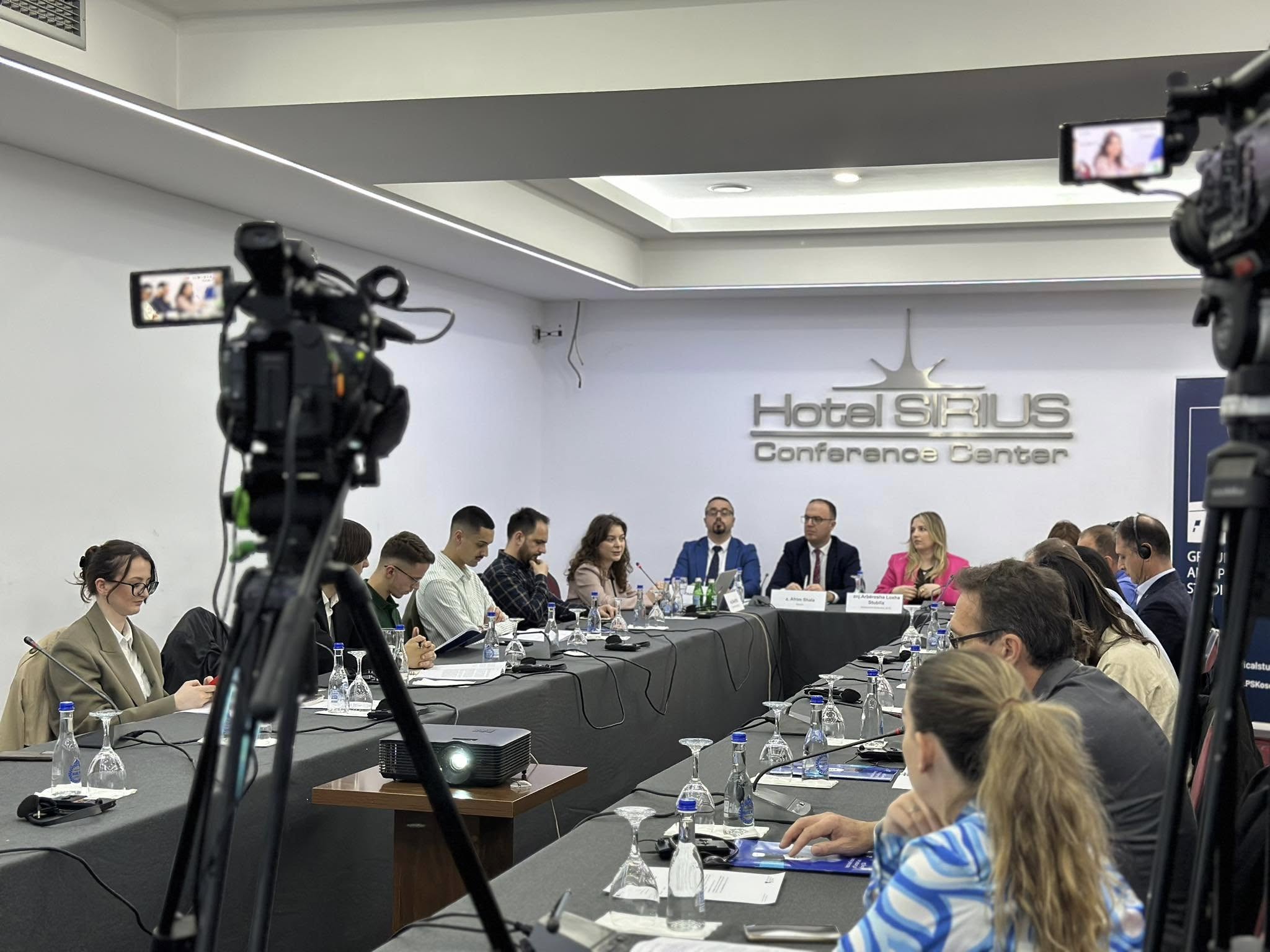
Prishtina, March 27, 2025 – Group for Legal and Political Studies (GLPS) organized a Roundtable Discussion on the topic: “How Did the Courts Handle Corruption Cases in 2024?”, held in Prishtina. The aim of this event was to discuss the performance, challenges, and shortcomings of the judicial system in handling corruption and organized crime cases, with a particular focus on high-profile corruption, based on regular court monitoring over a one-year period.
At the beginning of the discussion, GLPS present the annual report findings from the annual court monitoring of corruption and organised crime cases in several courts across Kosovo. This annual report covers a full-year monitoring period of January – December 2025, assessing the efficiency of the courts in handling corruption cases and identifying areas for improvement, on the basis of court sessions monitored and thorough analysis of available judicial decisions published during this period.
During this period, through the EU-funded ACT NOW initiative, GLPS monitored a total of 466 court sessions in the basic courts of Prishtina, Peja and Gjakova. In addition, a total of 78 court decisions available online were analyzed. Main findings prevail numerous persistent challenges, including frequent postponements and cancellations of court sessions mainly due to failure of parties to appear in courts. Although judges have the right, they usually fail to impose sanctions to ensure higher attendance of parties in procedure. In addition, a decline in transparency was noted, given that the number of decisions published during this period was half of what was in the previous monitoring periods, with many of those published surpassing the 60-day legal deadline for publication. Also, in 88% of decisions published there is no assessment of the financial damage or illegal gains due to corruption crimes committed.
Also, lengthy judicial procedures continue to characterize the system. Findings reveal that the average duration of a corruption trial was 732 days, with a typical case lasting 533 days. In high-profile corruption cases, GLPS noted significant delays and lenient sentences, failing to reflect the severity of the crime and the financial damage to the state budget.
This event gathered important institutional stakeholders, including judges, members of the Kosovo Prosecutorial Council, the Agency for the Prevention of Corruption, international organizations, and civil society.
Panelists:
Mr. Nicola SCARAMUZZO – Team Leader of the Rule of Law, EU Office in Kosovo
Mr. Afrim SHALA – Chairperson of the Commission for Monitoring, Evaluation, and Reporting of the Strategic Plan for the Efficient Resolution of Corruption and Organized Crime Cases
Mr. Visar KRASNIQI – Member, Kosovo Prosecutorial Council
Ms. Lindita ADEMI – Head of Division for Representation, Standardization and International Relations on the Agency for the Prevention of Corruption.
This activity was organized as part of the project titled: “ACT NOW – Supporting Public Administration Reform and Rule of Law through fighting corruption and improving service delivery”, funded by the European Union and implemented by Group for Legal and Political Studies.
Share article


Latest Publications
June 22, 2026
Policy Notes
An Outlook for 2026: Time for Kosova to Look Ahead
June 16, 2026
Policy Analysis
PAR Monitor Report Kosovo: Policy Development and Coordination 2024/2025
June 12, 2026
Policy Analysis
Western Balkan PAR Monitor: Policy Development and Coordination
Related Espresso Insights
July 2, 2026
Espresso.Insights
Peter Magyar on Kosovo: A shift or business as usual?
by GLPS

June 5, 2026
Espresso.Insights
Assisted Voting in Kosovo: Between Protecting Electoral Integrity and Limiting the Right to Vote
by GLPS