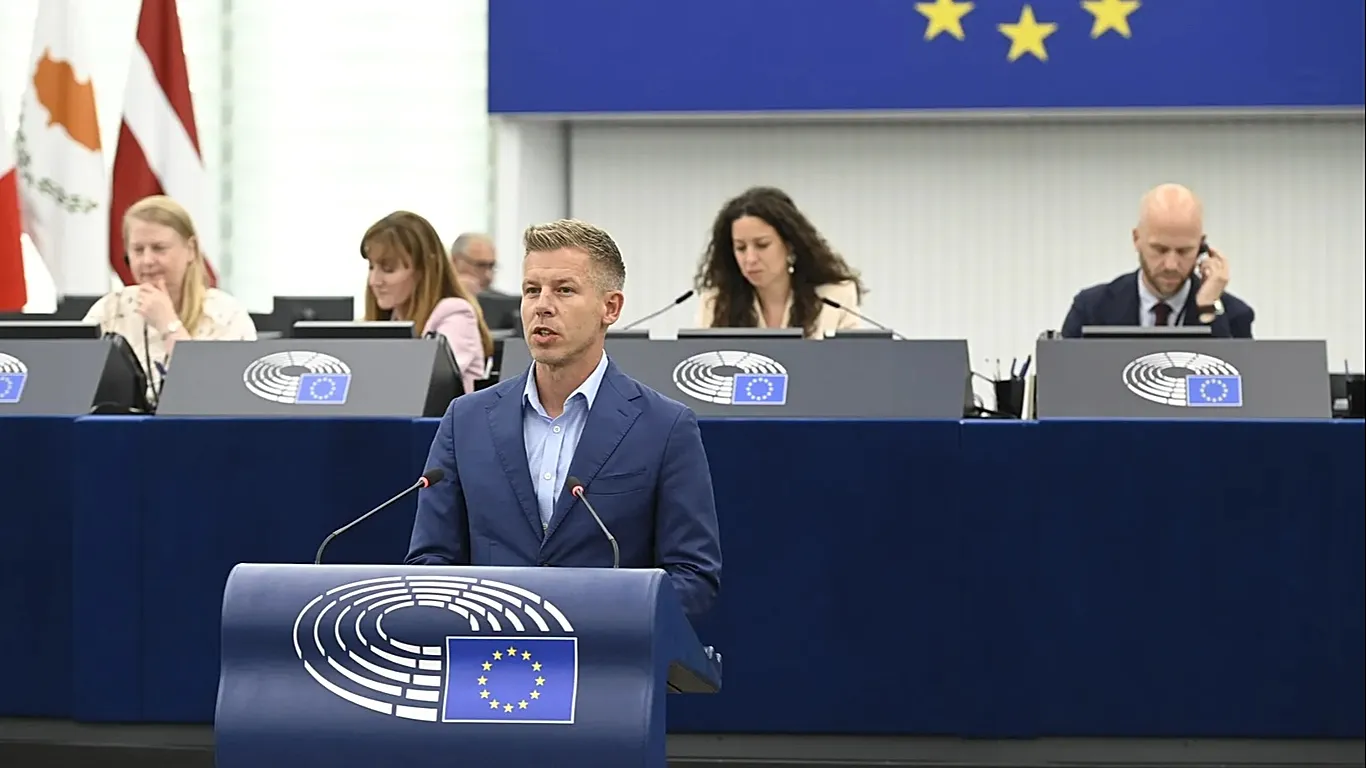
By: Joshua Archer – Clinton School of Public Service, Arkansas
The election of Péter Magyar has the potential to change Hungarian relations with the European Union (EU). With a policy of reconciliation with the EU proposed and a new Hungarian government which proclaims that they belong within the European system, it’s, on the surface, a hard rejection of Viktor Orbán’s policy of defiance. What this means for European Union hopefuls in the Western Balkans, especially Kosovo, is not yet clear. The new Prime Minister’s government could have a myriad of effects on Kosovo, especially in terms of the interstate relationship.
Hungary and Kosovo’s relations have been historically positive. Hungary’s deployment of a peacekeeping force in Kosovo was acclaimed as successful. Hungary still manages part of Kosovan air space and participates in the Kosovo Force (KFOR). Hungary has been in favor of EU enlargement and stability toward the Western Balkans in general. After the election of Orbán’s government, Hungary continued to develop a positive relationship with Kosovo. This is in spite of a shift toward a standoffish European policy and populist rhetoric. Economically the two states began to intertwine, although the Kosovo-Hungary trade did not number among either country’s biggest. Hungary has viewed Kosovo as important to the stability of the Balkans and has engaged with Kosovo to a greater degree than several of its Central European neighbors.
While Hungary recognizes Kosovo as an independent state, the government of Orbán did not prove willing to extend a hand diplomatically. Although Hungary has accepted Kosovan membership in several international institutions (such as the World Bank and International Monetary Fund), Hungary has voted against Kosovo’s EU membership bid in a show of support for Belgrade. Hungary has also voted against Kosovo’s entry into the Council of Europe and the United Nations. The official Hungarian position is that a formal agreement must be made between Kosovo and Serbia in order for Kosovo to apply for these organizations, especially since Serbia is another EU enlargement candidate.
Hungarian relations with Serbia prove to be important, especially considering Orbán’s close relationship with Serbian president Aleksandar Vučić. Serbia has long been a Hungarian ally, with Hungary focusing heavily on Serbia’s potential EU membership and engaging in new strategic partnerships, according to media aligned with Orbán’s government. Orbán has relied on Serbia to stem migration flows from its southern border. Their regimes are both ideologically similar, having been classified as ‘mixed regimes’ that teeter on the border between a democracy and a dictatorship. This could explain the insistence on reaching a proper agreement in Hungary’s vetoing of Kosovo’s admittance to international organizations. Not wanting to jeopardize relations with Serbia, a European state with a similar government, was important to future EU enlargement and the potential that Serbia’s joining could have meant another ideological ally was in the bloc. Now that Orbán is gone, the new Hungarian government’s approach to Serbia will have ramifications for Kosovo.
Magyar has made statements about Serbia, specifically in regards to the Hungarian minority in Vojvodina which have voting rights in Hungary. In these statements he discussed how he wished to cooperate with the Hungarian party in Vojvodina, but acknowledged their role as linked to the Orbán regime. The party, the Alliance of Vojvodina Hungarians (VMSZ), was strongly supporting Orbán in the latest election. They exist having to hold themselves accountable to both the Hungarian government and the Serbian, and the treatment of the Hungarian minority in Serbia is a potential point of contention, especially considering Magyar is promising to bring in new governmental reforms which Serbia lacks. There has also been a public row wherein Magyar accused Vučić (as well as Slovak prime minister Robert Fico and Orbán) of being puppets of Putin. This came in the aftermath of an (purported) attempted bombing of a fuel line (the TurkStream gas line) which transported Russian gas to Hungary, and which Magyar claimed was a false flag operation. Regardless of the legitimacy of the operation, and regardless of Vučić’s apparent willingness to be friendly with Magyar (as stated in the article), this row could display a less-cozy attitude toward Belgrade in Magyar’s government.
Hungarian relations with Russia also play into this equation. Hungary had set itself up under Orbán as a Russian ally in Europe, with acceptance of Russian natural gas and political blockading of EU resolutions to support Ukraine. But with the election of Magyar, who has taken a comparatively anti-Russian tone, Russia appears to have lost a steadfast ally. For Kosovo, this could imply a more cooperative Hungary willing to support further ascension measures, or at least not block them in opposition to other affirming or abstaining EU members. A more pro-European outlook could foster more cooperation and lead to Kosovo’s bid to ascend easier, at least as long as Magyar or his party remains in power.
Magyar has appeared to shift away from Orbánist thought in foreign policy as with domestic policy. However, the potential for less change that may be expected must be accounted for. It is important to note that Magyar was an Orbán insider before his turn against the party, and that his brand of pro-European conservatism could turn out to be more of an attempt to shift the EU into a more nationalistic organization. Just because Magyar offers a pro-European policy does not necessarily mean he’s the same type of pro-European as would be most beneficial to Kosovo. It is still too early to say exactly what his foreign policy will be, and Magyar could easily represent less of a change than is desired.
I see three different scenarios stemming from Magyar’s tenure as Hungarian prime minister. First, the situation for Kosovo will improve. Hungary will lift its demanding requirements for an agreement with Serbia for Kosovo to join international organizations, and perhaps this will lead to better ties with Hungary and more economic integration. It is too early to tell if relations with Serbia will turn south during Magyar’s tenure, but he appears to be less friendly towards the political establishment, at least in rhetoric. Considering Belgrade’s similarity to Orbán’s Hungary, the best-case scenario for Kosovo may be that Hungary reaches out once again to find an alternative ally in the Balkans.
Second is the possibility that things might get worse. In an attempt to enlarge the EU into the Western Balkans or in an attempt to cozy back up to Serbia, Magyar may retread Orbánist foreign policy tropes, including the blocking of Kosovar membership in international organizations. It remains to be seen how focused Hungary is on EU enlargement, but Kosovo may not be as high on the priority list compared to candidates like Albania or Montenegro. I count this option as the least likely due to Hungary’s current emphasis on rejecting the Orbán doctrine and pursuing a more pro-European foreign policy.
The third and final outcome I can see is little change, if any. Hungary may not have incentive to make Kosovo a focus of their foreign policy under Magyar’s tenure, especially with present matters like sweeping domestic reform and the war in Ukraine. In addition, if Hungary’s ideal for the Western Balkans is stability, it wouldn’t make sense to jeopardize relations with Serbia harshly by helping Kosovo to a greater extent. It remains to be seen, however, whether Magyar is as interested in stability as Orbán was.
I would put the most weight behind the third outcome – I do not believe there is yet enough evidence to suggest that Magyar’s foreign policy toward Kosovo will be radically different from Orbán’s. As Orbán’s policy was not outwardly hostile, I do not see Magyar’s being increasingly hostile. I also do not envision Magyar being blind to relations with Serbia and supporting Kosovo wholesale, even if they do participate in peacekeeping. Magyar instead is likely going to travel a pragmatic path where Kosovan relations are important. However, Vučić has been one of Orbán’s greatest enablers. As Magyar has rebutted Orbán’s government, it is possible that Serbia could be at the receiving end of grief from Hungary. There is a possibility that relations with Serbia could reach a breaking point, especially if Magyar demands additional minority rights, as they have done in Ukraine. Magyar could pursue Kosovar relations and support their EU and NATO ascension bids, especially if it appears to be a more promising path to stability within the Western Balkans than supporting Vučić.


Share article


Related Espresso Insights
July 2, 2026
Espresso.Insights
Peter Magyar on Kosovo: A shift or business as usual?
by GLPS

June 5, 2026
Espresso.Insights
Assisted Voting in Kosovo: Between Protecting Electoral Integrity and Limiting the Right to Vote
by GLPS

Latest Publications
June 16, 2026
Policy Analysis
PAR Monitor Report Kosovo: Policy Development and Coordination 2024/2025
June 12, 2026
Policy Analysis
Western Balkan PAR Monitor: Policy Development and Coordination
April 10, 2026
Policy Analysis