Authors

Naser Shamolli
public administration reform, rule of law and good governanceThe original version of this Espresso Insight is in Albanian, and can be found here.
Almost every time the process of forming a government emerges, the number of ministries to be proposed is reviewed. Such decisions have been accompanied by criticism, including from GLPS, for the large number of ministries and especially their cabinets. Consequently, as a result of the large number, legal and political initiatives have been taken to limit this number, but they have not always proven effective in practice. The dilemma remains whether limiting the number of ministries should be done by law or whether this is a matter for the Government.
The first initiative to limit the number of ministries by law was in 2018, finalized in 2020, when a maximum number of ministries was set at 15+2 through a draft law on the Government. The Venice Commission’s opinion on this draft law emphasizes that the Constitution prevents the Assembly from determining a number of ministries through a law, but recommends the use of objective criteria to determine the necessity for determining the number. The opinion recognizes the amendment of Article 96.2 of the Constitution as an alternative to overcoming this constitutional obstacle. As a result of this opinion but also constitutional dilemmas, the Government law approved in 2022 and which is in force, no longer contains a limitation on the number of ministries.
The issue of determining the number of ministries must be viewed from the perspective of the principle of separation of powers, set out in Article 4 of the Constitution. Therefore, the possibility for the Government to determine the number of ministries by internal act must be interpreted and understood together with this principle and with the system of checks and balances between the powers themselves.
That said, with the constitutional arrangement, determining the number of ministries is at the discretion of the Government. The Government is directly authorized by the Constitution to determine the number of ministries by internal act, while the Assembly through its own mechanisms can limit the Government in the creation of ministries and its own size. In this case, size does not strictly mean the number of ministries but human resources, including cabinets and civil servants.
Since the Government’s authorization to determine the number of ministries is source-based and is determined by the Constitution itself, this does not exclude the dual responsibility it has in relation to the spending of public money, but also the political responsibility it has towards the Assembly.
As much as the Government is “free” to determine the number of ministries, as the opinion of the Venice Commission emphasizes, there should be some limitations by setting some objective and measurable criteria for this purpose. From the past years there were bad practices and lessons regarding the number but also the “artificial” merger of some ministries that have caused a lot of damage both in their personnel and in the fulfillment of their duties. A typical case is that of the merger of the Ministry of Public Administration and the Ministry of Internal Affairs. Although within the same sector, the scope of activities of these two ministries were different and in practice led to unbalanced prioritization.
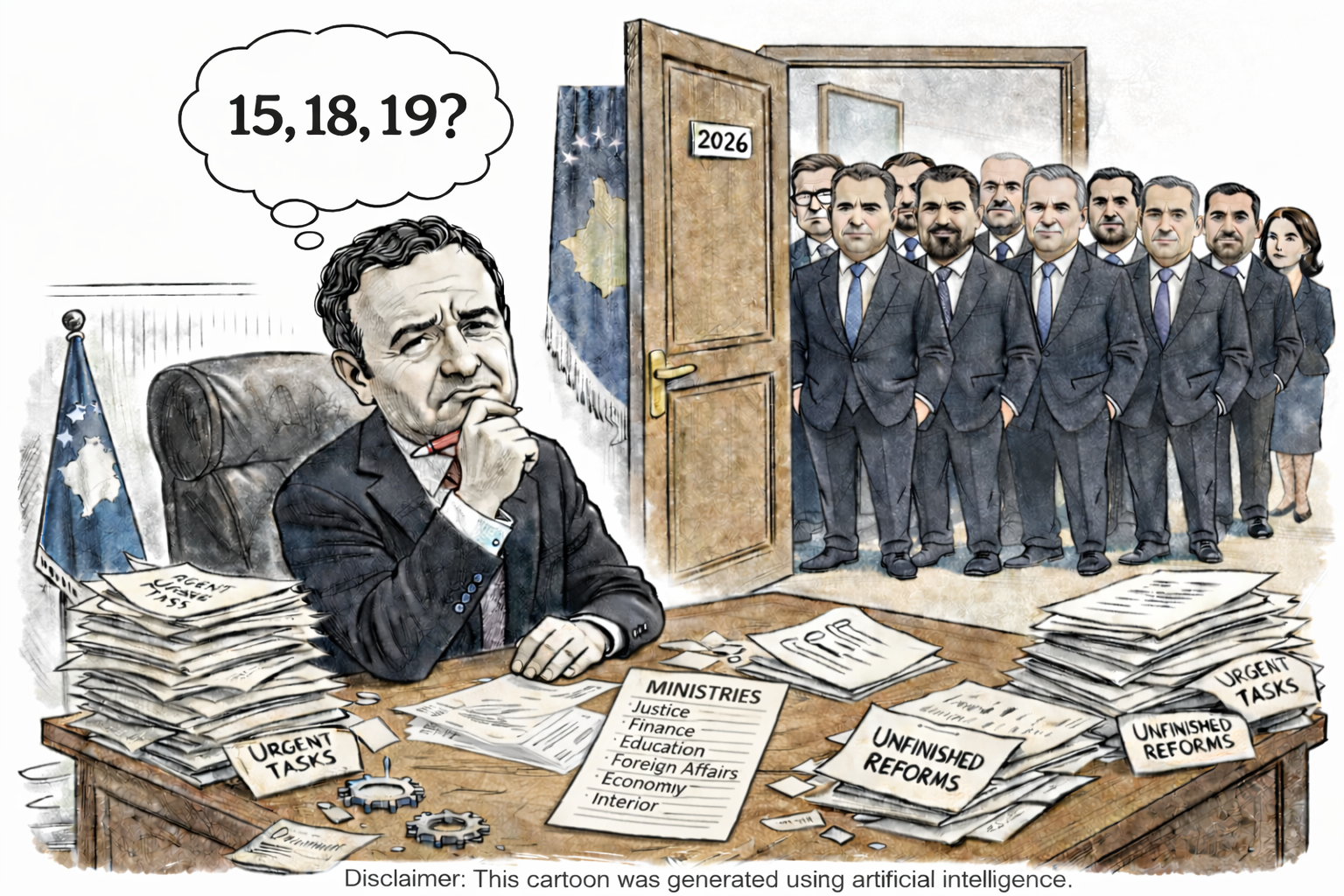
In the new composition of the Kurti III Government, the number of ministries has increased from 15 to 19. This increase includes the reinstatement of the Ministry of Public Administration, a decision that can be argued as necessary in the context of public administration reform and coordination of civil service policies. However, in parallel with this, new ministries are to be established without a clear analysis of the functional and institutional need, mainly through the separation of existing ministries. An illustrative example is the establishment of the Ministry of Sports and Youth, which for more than two decades has functioned within the Ministry of Culture. This approach is an indication that the expansion of the government is more the result of political considerations than of real need. This increase produces direct implications, increasing the budget, creating the need for new leadership structures, additional managerial positions and new coordination mechanisms. This process becomes even more complex when it comes to the reorganization and classification of jobs. In retrospect, if we evaluate the 2021 government reorganization, these processes have not been completed for most public institutions.
GLPS considers that one of the scenarios that can be applied for the number of ministries and that is more accurate in terms of the scope of the ministries to be created is the sector-based one. There are several types of sectors on the basis of which ministries could be created, which are presented as follows and which can also serve in determining the number and type of ministries:
- The Center of Government, which may have under its competences the Office of the Prime Minister (which exercises functions of coordination, control of policies and legislation, as well as their monitoring), executive agencies which are established to cover functions of government coordination or of a horizontal nature.
- Foreign Affairs, which may include the Ministry of Foreign Affairs
- Good Governance, which may include the Ministry of Public Administration and the Ministry of Local Government.
- Rule of Law, which may include the Ministry of Justice.
- Defense and Security, which may include the Ministry of Defense and the Ministry of Internal Affairs
- Public Finance, which may include the Ministry of Finance.
- Economic Development, which may include the Ministry of Economy, Trade and Industry.
- Infrastructure and Environment, which may include the Ministry of Environment and the Ministry of Infrastructure.
- Education, Science and Innovation, which may include the Ministry of Education, Science and Innovation.
- Culture, Sports and Tourism, which may include the Ministry of Culture, Sports and Tourism
- Health and Social Welfare which may include the Ministry of Health and the Ministry of Labor and Social Welfare.
All existing ministries and their scope of activity that are not part of the sectors above can be merged, that is, become part of a ministry based on the typical characteristics they have according to the sector.
As for European integration, being a priority for the country, it requires a centralized structure that ensures the effective implementation of reforms and obligations. It is important that its scope remains within the Office of the Prime Minister or potentially be established as an Executive Agency, due to the nature of its horizontal and coordinating functions.
In 2008 and 2009, a functional review process of the Government and ministries was completed, but the recommendations that emerged from this review were never seriously considered. These recommendations are still valid and can be applied today so that when discussing the number and scope of ministries, accurate and objective methods based on evidence are followed.
In conclusion, the Government can determine the number of ministries but based on some objective and need-based criteria, as well as taking into account the functional analysis and features of the scope of each ministry. The Government remains responsible and accountable for the efficient spending of public money, effectiveness in sectors both before the Assembly and the public.
Government Size: Functional Need or Political Calculation?

 Download PDF
13/02/2026
Download PDF
13/02/2026Share article


Related Espresso Insights
July 2, 2026
Espresso.Insights
Peter Magyar on Kosovo: A shift or business as usual?
by GLPS

June 5, 2026
Espresso.Insights
Assisted Voting in Kosovo: Between Protecting Electoral Integrity and Limiting the Right to Vote
by GLPS
Latest Publications
June 16, 2026
Policy Analysis
PAR Monitor Report Kosovo: Policy Development and Coordination 2024/2025
June 12, 2026
Policy Analysis
Western Balkan PAR Monitor: Policy Development and Coordination
April 10, 2026
Policy Analysis